
Gallingertown Cemetery History
Historical Background
St. George’s Anglican Cemetery, commonly known as St. George’s Cemetery or Gallingertown Cemetery, is a small but historically significant burial ground located on County Road 18, near Groves Road, in South Stormont, Ontario.
Situated on Lot 35, Concession 4, in the former Township of Osnabruck, the cemetery preserves important connections to the Loyalist settlement of the region, the War of 1812, generations of Anglican worship, and the history of the community from which Gallingertown received its name.
The earliest burial identified in the surviving grave list is Michael G. Gallinger, who died on January 10, 1851, at the age of 54. This indicates that the burial ground was in use before the first documented church building was constructed in 1854.
The Gallinger Family and the Origins of Gallingertown
The Gallinger family originated in Germany, settled first in central New York State, and later came to this region as United Empire Loyalists. George Gallinger Sr. served with the King’s Royal Regiment of New York during the American Revolution. Following the war, the family settled in Stormont County on land associated with Loyalist military service.
His son, George Gallinger Jr., was born in Osnabruck Township on October 7, 1788. During the War of 1812, both father and son served with the 1st Regiment of the Stormont Militia. Members of this regiment participated in military actions associated with Ogdensburg, Salmon River, and the campaign culminating in the Battle of Crysler’s Farm on November 11, 1813. Fighting at Hoople’s Creek occurred the preceding day.
In 1816, George Gallinger Jr. received an Order in Council for a land grant. He married Jane Cameron in 1818, and together they raised a large family.
The Gallinger family became so closely associated with the surrounding agricultural settlement that the community eventually became known as Gallingertown.
George Gallinger Jr. died on December 14, 1879, at the age of 91, and was buried in St. George’s Anglican Cemetery. His gravestone remains an important historical link between the cemetery, the Loyalist settlement of Upper Canada, and the War of 1812.
The First St. George’s Anglican Church
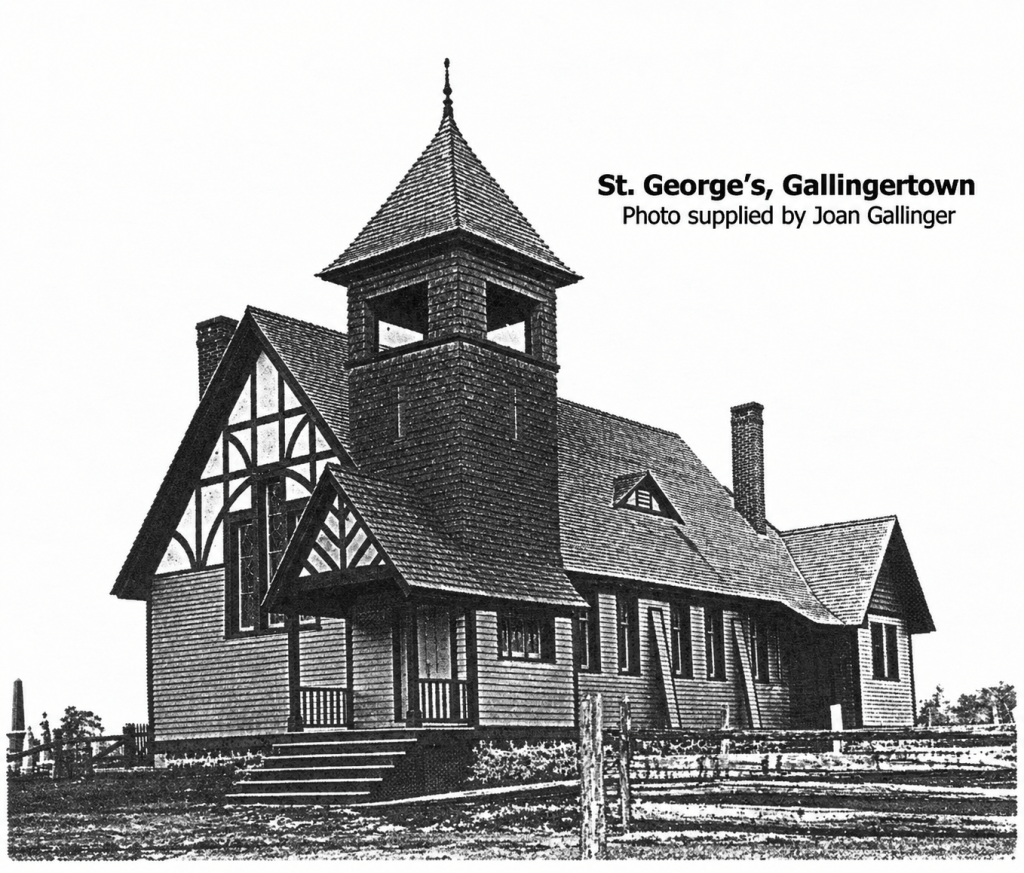
The history of St. George’s Anglican Church is closely intertwined with the Gallinger family and the development of Gallingertown.
In 1854, descendants of the original Loyalist settlers constructed a small wooden church to serve the growing Anglican congregation. The church provided a place for worship, baptisms, marriages, funerals, and community gatherings.
The church and its adjoining burial ground were formally consecrated on January 18, 1874, by Bishop John Travers Lewis, the first Bishop of Ontario.
The cemetery had already been in use for several decades, and its surviving gravestones provide evidence of the families who lived, worshipped, and worked in the surrounding community.
As the congregation grew, the original wooden church eventually became inadequate for its needs. By the closing years of the nineteenth century, plans were underway to construct a larger and more substantial building immediately east of the cemetery.
The New St. George’s Anglican Church (1897–1899)
By the late nineteenth century, the Anglican congregation at Gallingertown had grown sufficiently to warrant the construction of a larger church.
In 1897, a cornerstone-laying ceremony marked the beginning of construction of a new St. George’s Anglican Church, immediately east of the cemetery. The ceremony was a significant community occasion, featuring music by the Osnabruck Brass Band. Coins, stamps, and various church papers were placed within the cornerstone as a record for future generations.
The building contractor was Nelson Gallinger, working with Ottawa architect R. H. A. Walls. Together, they created an impressive church in the Arts and Crafts architectural style popular during that period.
The new church was formally consecrated by Bishop Charles Hamilton on November 14, 1899. Historical accounts describe a day of religious services and refreshments extending into the evening. The offerings collected during the celebration amounted to approximately $90, a substantial contribution at the time.
The church was an attractive and substantial building, reportedly capable of accommodating as many as 300 people. Its interior featured dark wooden ceiling beams, doors, and trim, contrasting with lighter-coloured pews and altar furnishings. Above the altar appeared the words, “I am the bread of life.”
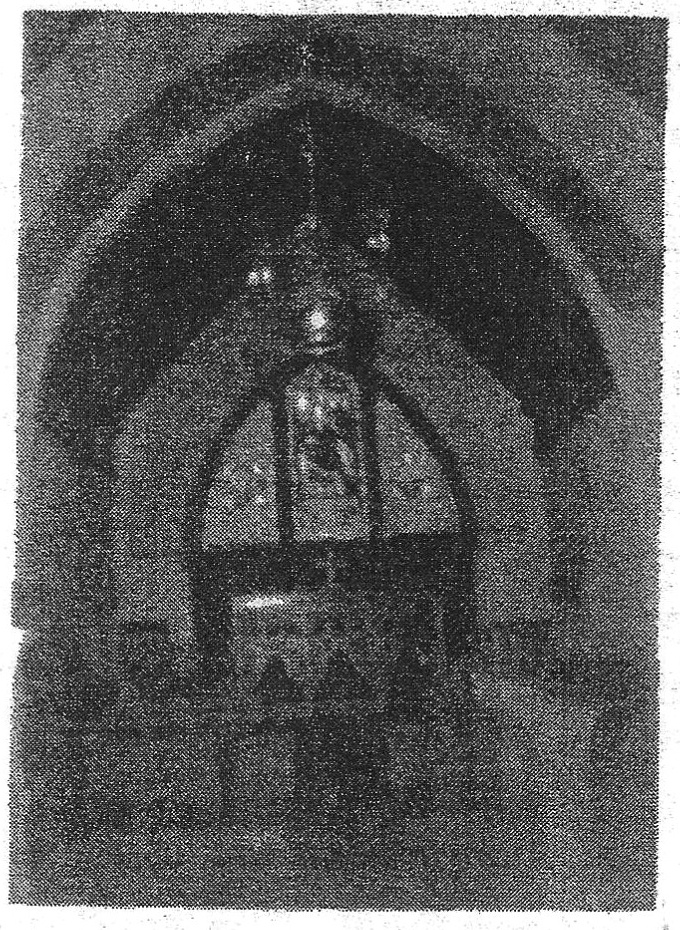
For generations, St. George’s Anglican Church served as an important centre of religious and community life in Gallingertown. Its stained-glass windows, marble baptismal font, and distinctive architecture became cherished features of the building.
The Closure of St. George’s Church and the Seaway Era
In 1954, changes were announced that would eventually bring an end to nearly a century of Anglican worship at St. George’s Church in Gallingertown.
At that time, St. George’s was associated with the parish of Aultsville, one of the communities affected by the construction of the St. Lawrence Seaway and Power Project. As plans advanced for the flooding of Aultsville, decisions were made to reorganize the area’s Anglican congregations.
St. George’s at Gallingertown and St. Paul’s at Aultsville were both closed, with their congregations transferring to the new St. Peter’s Anglican Church in Ingleside.
On September 28, 1957, at 4:30 p.m., a formal act of secularization took place at St. George’s Anglican Church, marking the end of its use as a consecrated place of worship.
Although the building survived the immediate Seaway construction period, it was subsequently sold and demolished in 1970.
Fortunately, several important furnishings and artifacts were preserved and transferred to other churches.
The church bell was relocated to St. Martin’s Anglican Church in Ottawa. Stained-glass windows were installed at Christ Church in Long Sault, where they continued to welcome worshippers entering through the west doorway.
The handsome marble baptismal font was moved to Christ Church in Upper Canada Village, preserving another tangible connection to the former Gallingertown congregation.
Today, trees grow on the site where St. George’s Church once stood. Although the building itself has disappeared, its cemetery remains as an enduring reminder of the families and community it served.
In 2002, Joan Gallinger compiled a history of St. George’s Church and Cemetery and presented it to Christ Church in Long Sault, helping preserve the story of this important local institution for future generations.
The Cemetery and Its Historic Gravestones
St. George’s Anglican Cemetery occupies approximately 0.53 acres (2,152 square metres) on County Road 18, near Groves Road, in the former Township of Osnabruck.
Although relatively small, the cemetery contains an important collection of nineteenth- and twentieth-century gravestones documenting generations of families associated with Gallingertown and the surrounding farming community.
According to the Township of South Stormont Cemetery Master Plan, the cemetery contains approximately 48 standing grave markers and 17 complete or partial monuments preserved horizontally.
An earlier historical grave list recorded 50 numbered monument entries, including several stones commemorating more than one individual. These figures represent different methods and periods of documentation and will require reconciliation through updated fieldwork.
Among the cemetery’s most historically significant burials is George Gallinger Jr. (1788–1879), a veteran of the War of 1812 whose family played an important role in the settlement and development of Gallingertown.
The cemetery also contains monuments associated with the wider Anglican congregation and local families whose lives contributed to the agricultural, religious and community history of Osnabruck Township.
Over time, weathering, vandalism and the natural deterioration of gravestones have affected some of these monuments. Preserving their inscriptions and documenting their locations are important priorities for ensuring that the cemetery’s historical record is not lost.
Remembering a War of 1812 Veteran
On November 7, 2015, a special graveside ceremony was held at St. George’s Anglican Cemetery to honour George Gallinger Jr. (1788–1879), a veteran of the War of 1812 and a prominent member of the family from which Gallingertown received its name.
The ceremony formed part of the War of 1812 Graveside Project, an initiative dedicated to identifying and commemorating the final resting places of veterans who served in the defence of Upper Canada.
George Gallinger Jr. had served with the 1st Regiment of the Stormont Militia during the War of 1812. His military service connected him to an important chapter in Canadian history, including the campaign surrounding the Battle of Crysler’s Farm in November 1813.
The commemorative gathering brought together descendants of the Gallinger family, local historians, community representatives, and members of the Stormont, Dundas and Glengarry Highlanders.
A special graveside marker was unveiled to recognize Gallinger’s military service and ensure that future generations would understand the historical significance of his resting place.
The ceremony also highlighted the importance of preserving small rural cemeteries, where the gravestones of early settlers and military veterans provide lasting connections to the people and events that shaped our communities.
Today, George Gallinger Jr.’s grave serves as a reminder of the contributions made by Loyalist families and local militia members to the history of Upper Canada.
Cemetery Restoration and Preservation
Like many historic rural cemeteries in Eastern Ontario, St. George’s Anglican Cemetery has faced considerable challenges over the years, including weathering, deterioration of gravestones, and acts of vandalism.
During the early twenty-first century, several historic monuments were damaged or displaced, raising concerns about the long-term preservation of the cemetery and its irreplaceable historical inscriptions.
In 2009, a community fundraising initiative raised approximately $12,000 to undertake much-needed restoration work. Damaged monuments were repaired where possible, and several fragile gravestones were carefully repositioned horizontally within a raised memorial structure to protect their surviving inscriptions.
In 2010, a new cemetery sign was purchased, helping identify the burial ground and recognize its historical importance.
These efforts demonstrated the commitment of local residents, descendants, and volunteers to protecting a cemetery that had served the Gallingertown community for generations.
Today, the South Stormont Cemetery Preservation Association is working to build upon earlier preservation efforts through the documentation, mapping, and conservation of historic cemeteries throughout South Stormont.
For Gallingertown Cemetery, this includes reconciling existing burial records, documenting surviving gravestones, identifying monuments requiring conservation, and developing an accessible historical record for researchers, genealogists, descendants, and future generations.
By combining historical research with modern cemetery documentation and responsible conservation practices, the Association hopes to ensure that the people buried at St. George’s Anglican Cemetery, and the community they helped establish, will not be forgotten.
Historical Sources and Continuing Research
Much of our understanding of St. George’s Anglican Church and Cemetery has been preserved through the dedication of local historians, descendants, and community volunteers.
Of particular importance is the historical research compiled by Joan Gallinger in 2002. Her account documents the development of St. George’s Anglican Church, its clergy, parish affiliations, furnishings, and eventual closure. This valuable record was preserved in the archives of Christ Church in Long Sault.
Additional information has been drawn from the Township of South Stormont Cemetery Master Plan, historical gravestone transcriptions, Anglican parish records, newspaper accounts, and documentation associated with the War of 1812 Graveside Project.
As with many historic cemeteries, some questions remain unanswered. These include the precise circumstances surrounding the establishment of the burial ground, the original land transactions, the location of the successive church buildings, and discrepancies among surviving cemetery inventories.
The earliest identified burial dates to 1851, three years before the construction of the first documented church building in 1854. This suggests that the cemetery was already serving local families before the church was established.
Further examination of historical deeds, church registers, municipal records, and original documents may help clarify these questions.
The South Stormont Cemetery Preservation Association welcomes additional historical information, photographs, family records, and corrections from descendants and researchers.
Our objective is to maintain an accurate and evolving historical record that honours those buried at Gallingertown Cemetery and preserves their stories for future generations.
Historical References and Acknowledgements
The South Stormont Cemetery Preservation Association gratefully acknowledges the contributions of historians, researchers, descendants, and volunteers whose work has helped preserve the history of St. George’s Anglican Church and Cemetery.
Principal Historical Sources
- Joan Gallinger (2002): Historical account of St. George’s Anglican Church and Cemetery, preserved in the archives of Christ Church, Long Sault.
- Township of South Stormont: Cemetery Master Plan, Section 4.2.7, St. George’s Anglican Cemetery.
- Historical Cemetery Transcriptions: Earlier gravestone inventories and burial records documenting individuals interred at Gallingertown.
- Anglican Parish Records: Historical information concerning the church’s construction, consecration, parish affiliations, and closure.
- The Morrisburg Leader (November 11, 2015): Coverage of the War of 1812 Graveside Project ceremony honouring George Gallinger Jr.
- War of 1812 Graveside Project: Documentation concerning the commemoration of veterans buried in historic Canadian cemeteries.
Special Acknowledgement
Joan Gallinger — Historical Research and Documentation
The South Stormont Cemetery Preservation Association gratefully acknowledges Joan Gallinger for her dedicated research into the history of St. George’s Anglican Church and Cemetery. Her 2002 historical account, together with the photographs and documentary information she preserved, provides an invaluable foundation for understanding the history of Gallingertown and its Anglican community.
George Gowsell — Cemetery Preservation and Digital Archiving
The Association extends its sincere appreciation to George Gowsell for his generous financial commitment to the preservation of St. George’s Anglican Cemetery.
Through his personal funding, the cemetery’s gravestones are being systematically documented and archived, with their inscriptions and associated burial information incorporated into a searchable digital database.
This important initiative will help preserve the cemetery’s historical records, support genealogical and historical research, and make information about those buried at Gallingertown more accessible to descendants, researchers, and future generations.
George’s generosity represents a significant contribution to the long-term preservation of Gallingertown’s heritage and demonstrates the important role that individual community members can play in safeguarding our local history.
The South Stormont Cemetery Preservation Association is deeply grateful to both individuals for their contributions to preserving the history of St. George’s Anglican Cemetery.

