Dixon Cemetery is a small historic burial ground located at the corner of Wilburn Road and County Road 12, south of Newington, Ontario. Situated across from Dixon Road, it occupies approximately 1,700 square metres, or 0.42 acres, on Lot 7, Concession 6 in the former Township of Osnabruck.
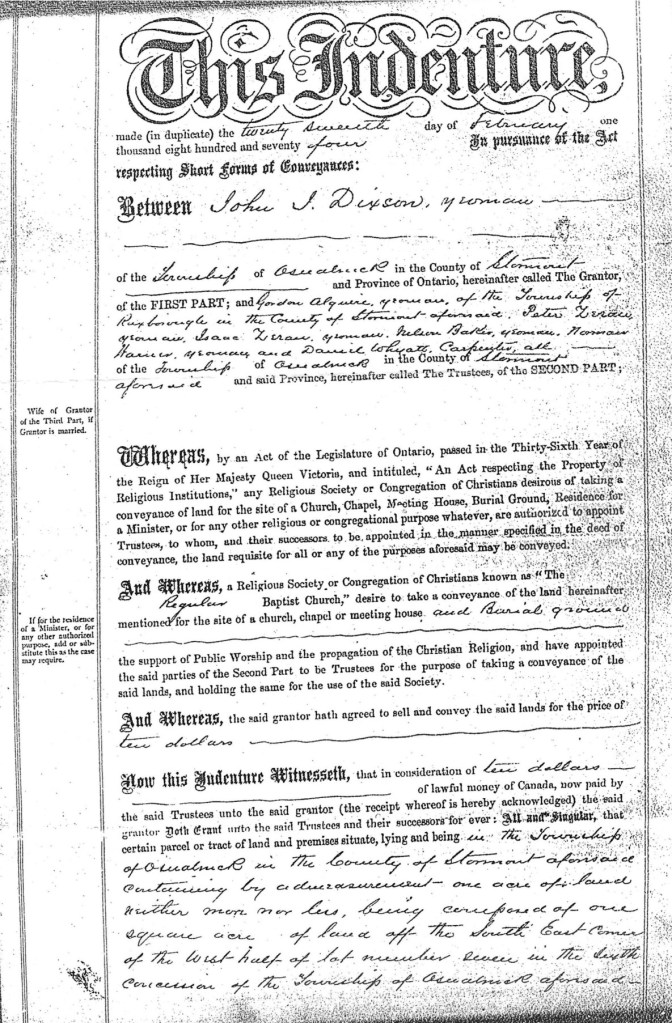
The cemetery is also historically known as the Baptist Church Cemetery. Earlier versions of this history relied on a less legible copy of the original conveyance. The improved images reproduced in this revision establish that the indenture was made on February 27, 1874. It conveyed land from John J. Dixon, a yeoman of Osnabruck Township, to trustees for the Regular Baptist Church for a church, chapel or meeting house and burial ground. The consideration stated in the deed was ten dollars. The earliest identified grave marker dates from 1876, closely following this documented conveyance.
The 1874 Conveyance.
The original indenture is one of the most important surviving documents in the history of Dixon Cemetery. Its first page identifies John J. Dixon as the grantor and names a group of local men as trustees for the Regular Baptist Church.
The deed describes the property as one square acre, more or less, taken from the southeast corner of the west half of Lot 7 in the Sixth Concession of the Township of Osnabruck. It expressly states that the congregation desired the land for the site of a church, chapel or meeting house and burial ground. This is direct documentary evidence that burial use formed part of the intended purpose of the property from the time of the 1874 conveyance.
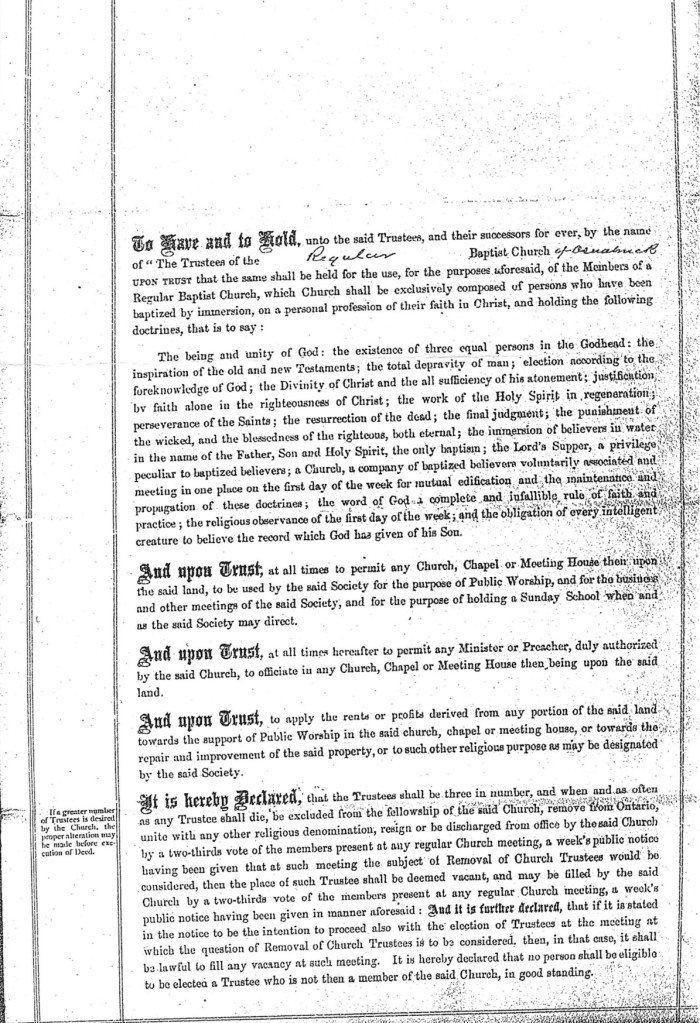
The printed trust provisions are unusually detailed. They provide for use of the property by the Regular Baptist congregation, authorize religious worship and related church purposes, set out the responsibilities and succession of trustees, and address what was to occur if the local church ceased to exist.
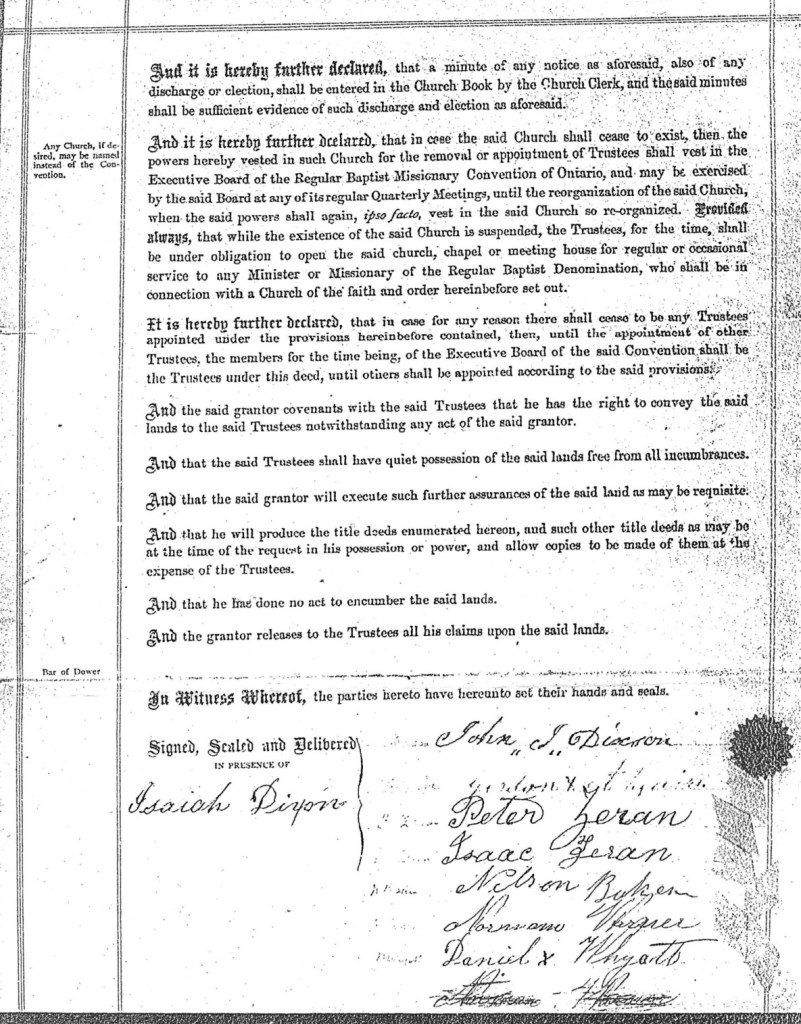
The final page contains the execution clause, John J. Dixon’s signature and the names and signatures associated with the execution of the deed, including Peter Zeran. Peter Zeran was the great-grandfather of the cemetery’s present trustees, Barry Zeran and Shawn Zeran.
These pages are reproduced later in this history so that the original record remains connected with the cemetery narrative.
The Baptist Church at Dixon Cemetery.
The 1874 indenture established the property for the use of the Regular Baptist Church as the site of a church, chapel or meeting house and burial ground. Additional information from Beryl Morrison’s history, Two Centuries of Life in Osnabruck Township 1784–1984, helps explain what happened on the property following the conveyance.
A Church Is Built at Dixon
Morrison records that a frame Baptist church was built at Dixon in 1877 by Peter Zeran. She states that the building was used by the Baptists for only twelve to fourteen years, until a new church was built at Newington.
Shared with the North Lunenburg Presbyterians
Morrison also records that in 1877, while the Presbyterians at North Lunenburg were renovating their church, they used the Dixon Baptist building throughout the summer. This detail suggests that the newly constructed church served not only its own Baptist congregation but also assisted another local congregation while its place of worship was unavailable.
This provides an important link between the original deed and the physical church that once stood at Dixon. Peter Zeran was one of the trustees associated with the 1874 conveyance, and Morrison credits him with building the Baptist church three years later. The earliest identified gravestone presently associated with Dixon Cemetery dates from 1876, closely following the conveyance and preceding construction of the church.
The Move to Newington
According to Morrison, the Dixon Baptist church was used for approximately twelve to fourteen years before a new church was built at Newington. If that period is approximate, the transition would have occurred around 1889–1891. Morrison further states that the Dixon building was later sold to Clarence Hawn and removed. The church building therefore disappeared from the cemetery property, while the burial ground remained.
A Second Church-Building Account.
Another local account has not yet been fully reconciled with Morrison’s history. It states that a building formerly used by a Methodist Episcopal congregation was purchased by Jim Martin in 1888, moved and converted into a wheelwright shop. Four years later, in 1892, it was reportedly sold to the Baptist congregation of Newington for $240.
At present, the available evidence does not establish that Morrison’s 1877 Dixon Baptist church and the former Methodist Episcopal building were the same structure. They may represent separate buildings or different stages in the Baptist congregation’s move to Newington.
Until additional church records, deeds, photographs, newspaper accounts or other contemporary documentation are located, the two accounts should be preserved separately rather than reconciled by assumption.
Newington to Osnabruck Centre.
The church and cemetery remained closely associated for nearly a century. In 1986, Emmanuel Baptist Church amalgamated with its sister congregation, Bunker Hill Baptist Church at Osnabruck Centre. The combined congregation later became known as Emmanuel-Osnabruck Baptist Church and assumed responsibility for Dixon Cemetery.
The Bunker Hill Baptist congregation had been organized in 1841. A surviving centennial booklet records that the Osnabruck Baptist Church building served from 1853 to 1953. This evidence clarifies an apparent typographical error in the Township’s Cemetery Master Plan, which gave the construction date as 1953.
The congregation continued serving the Osnabruck Centre community until its doors closed in 2003. Following the sale of the Osnabruck Centre Baptist Church in 2004, funds were retained to help support the continuing care of Dixon Cemetery.
The Dixon Family Connection.
The cemetery takes its commonly used name from the many members of the Dixon family buried there and from its location across from Dixon Road. The surviving monuments and historical records reveal an extensive network of local families, including the Bartle, Bush, Dixon, Eamon, Empey, Hawn, Morgan, Rombough, Rupert, Warner and Zeran families.
One of the cemetery’s most distinctive features is its wooden entrance sign, which reads “Dixson Cemetery” rather than the more commonly used “Dixon Cemetery.” According to the Township of South Stormont Cemetery Master Plan, the alternate spelling resulted from an error made when the sign was prepared. Nevertheless, the sign has acquired an unintended historical significance and has become a recognizable part of the cemetery’s identity.
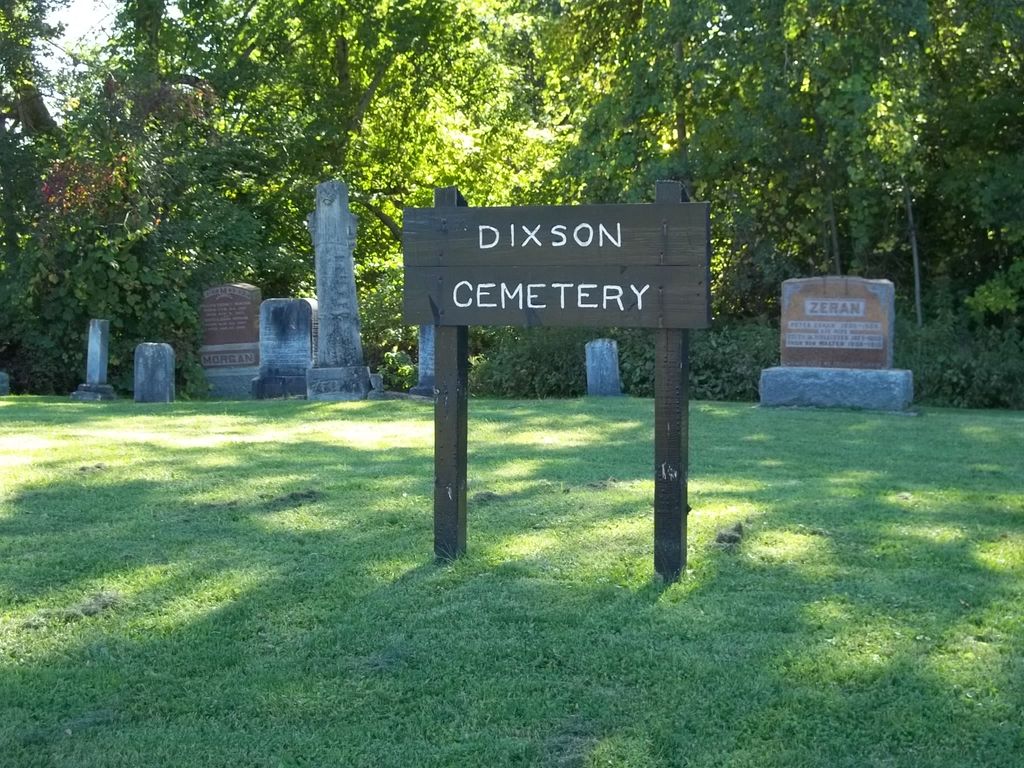
The Cemetery and Its Monuments.
Earlier municipal records estimated that approximately 55 burials could be identified within Dixon Cemetery. More recent comparisons of cemetery transcriptions, annotated records and genealogical sources have produced a consolidated list containing additional names connected with the cemetery.
Not every name on the expanded list has yet been confirmed by a surviving monument. On-site verification will therefore be required to establish which individuals are buried in the cemetery, identify possible unmarked graves, photograph the surviving inscriptions and resolve conflicting names and dates.
One particularly notable memorial is the Bartle family cenotaph. Its inscription records that the remains of certain family members lie beneath the waters of the St. Lawrence Seaway, connecting Dixon Cemetery with the larger history of the communities, burial grounds and family properties affected by the St. Lawrence Seaway and Power Project during the 1950s.
Several gravestones have been broken or displaced over time. The Township’s Cemetery Master Plan reported that approximately four or five damaged stones were leaning along the side of the cemetery and that their original locations were unknown.
These stones remain important historical artifacts. Any future repair, resetting or relocation should be carefully documented so that inscriptions, former locations and family associations are preserved wherever possible.
Care and Preservation.
Dixon Cemetery is considered an inactive cemetery and no longer regularly accepts burials. Its principal ongoing needs include grass cutting, general grounds maintenance, monument documentation and the conservation of damaged gravestones.
Responsibility for Dixon Cemetery is presently carried by Barry Zeran and Shawn Zeran, who serve as the current trustees charged with the maintenance and care of the cemetery. Barry and Shawn are first cousins and are both great-grandchildren of Peter Zeran, one of the trustees associated with the 1874 conveyance.
According to Beryl Morrison, Peter Zeran also built the frame Baptist church at Dixon in 1877. His signature appears in the execution section of the surviving indenture reproduced later in this history.
Continuity of Stewardship
This family connection provides a remarkable continuity of stewardship. Peter Zeran participated in the early trusteeship of property dedicated to Baptist worship and burial purposes and, according to Morrison, built the church that stood at Dixon.
Approximately a century and a half later, his great-grandchildren Barry and Shawn continue to care for the cemetery. The church itself is gone, but Dixon Cemetery remains a tangible link to the congregation, families and trustees who established and maintained this place.
More recently, Dixon Cemetery has become part of the work of the South Stormont Cemetery Preservation Association. Drone mapping, monument photography, digital recordkeeping and ground-verification initiatives are intended to identify surviving monuments, reconcile historical burial records and make the cemetery’s information more accessible to descendants, researchers and the public.
Preserving Dixon Cemetery’s Story.
Although the Baptist church that once stood at Dixon Cemetery has long since disappeared, the burial ground remains an important reminder of the religious, family and community life of nineteenth-century Osnabruck Township.
Its surviving gravestones, the original 1874 indenture, historical church records and the continuing involvement of the Zeran family provide valuable evidence of the cemetery’s origins and development.
Through the work of the South Stormont Cemetery Preservation Association, efforts are underway to bring together historical documents, burial records, photographs and monument information in a permanent and accessible digital record.
By preserving these materials and documenting the cemetery’s remaining monuments, we hope to ensure that the stories of the individuals and families associated with Dixon Cemetery will remain available to future generations.
The Original 1874 Indenture
Historical Sources and Research Notes
This history of Dixon Cemetery has been prepared by the South Stormont Cemetery Preservation Association using historical documents, published local histories, municipal records, cemetery transcriptions and information supplied by individuals associated with the cemetery.
Principal Historical Sources
- Original Indenture, February 27, 1874. Conveyance of land by John J. Dixon to trustees of the Regular Baptist Church for religious and burial purposes. The three surviving document pages are reproduced above.
- Beryl Morrison, Two Centuries of Life in Osnabruck Township, 1784–1984. Historical information concerning the Baptist church at Dixon Cemetery, Peter Zeran and the early religious communities of Osnabruck Township.
- Township of South Stormont Cemetery Master Plan. Information concerning the cemetery’s location, historical identification, entrance signage, estimated burials and monument conditions.
- Historical Baptist Church Records and Centennial Publications. Information concerning the development of the Baptist congregations at Dixon, Newington and Osnabruck Centre.
- Cemetery Monument Transcriptions and Burial Records. Historical inscriptions, family names and burial information associated with Dixon Cemetery.
- South Stormont Cemetery Preservation Association Research Records, 2026. Cemetery documentation, historical research, burial-list reconciliation and preservation planning.
Research Note
Some aspects of the cemetery’s history, particularly the accounts of early church buildings and the identification of individual burials, require further verification. Where historical sources differ, these differences have been acknowledged rather than treated as established facts.
This history will be updated as additional documents, photographs, burial records and other reliable historical evidence become available.
Prepared by the South Stormont Cemetery Preservation Association. Revised September 28, 2026.

